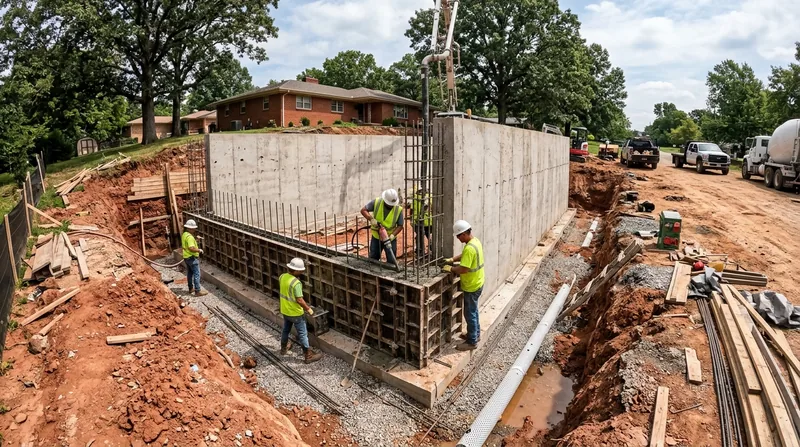




Concrete Retaining Walls in Tulsa: Built for Red Clay and Steep Hillsides
Tulsa sits where the Osage Hills drop into the Arkansas River valley, and that terrain punishes weak walls. Hillside lots in Gilcrease Hills, Maple Ridge and the streets around Turkey Mountain sit on red expansive clay over shallow shale and sandstone. That clay swells after a spring downpour and shrinks in a July dry spell, and it pushes on anything that isn't anchored deep enough. If you need Concrete Retaining Walls in Tulsa, you need a wall engineered for that ground, not a stack of block sitting on topsoil.
We pour reinforced concrete and build reinforced CMU block walls with engineered footings, rebar grids and working weep holes. These are the walls that hold when a driveway sits above them or a steep cut has to stay put behind a 1930s Tudor in Brady Heights. When a wall is leaning or has already dropped, start with leaning and collapsed wall repair before the damage spreads to the slab or the driveway.
We work across Tulsa and the surrounding towns, from Brookside bungalows to 1990s brick homes in south Tulsa. Every job starts with a look at the soil, the slope and what the wall has to hold back.
Why Tulsa Yards Fail Without a Real Concrete Wall
The dominant failure mode here is clay movement combined with water. Red expansive clay takes on water, swells, and shoves a wall outward until it leans. Freeze-thaw cycles in January and February work the same joints, and ice storms drop limbs and add load on top. Aging railroad tie walls in Brookside and Swan Lake are the classic casualty: the ties rot, the wall bulges, and the yard above starts sliding toward the house.
- Expansive clay pushes against a wall that has no proper footing or drainage behind it.
- Spring downpours saturate the soil and hydrostatic pressure builds faster than weep holes can relieve it.
- Freeze-thaw cycles open cracks in shallow walls and let water in behind the face.
- Rotting timber and tie walls lose their structural capacity after 15 to 25 years in Tulsa humidity.
- Hillside cuts around Turkey Mountain and Gilcrease Hills creep downhill when the toe isn't pinned.
A poured or reinforced block wall with a real footing and a drainage plane solves all five at once, which is why we push concrete on tall walls and anything carrying a surcharge.
Key info: A homeowner in Maple Ridge had a 5-foot tie wall holding up a parking pad behind a 1928 house. The ties had rotted through and the pad had dropped 3 inches. We replaced it with a reinforced CMU wall on a deepened footing and added a gravel drainage plane, and the pad came back level.
Local rules matter too. Many Tulsa-area jurisdictions require a permit once a wall passes roughly 4 feet measured from the footing, or whenever it supports a driveway or structure. Engineered drawings are often required for tall or tiered walls. Confirm the current threshold with the City of Tulsa building department before you dig.
How We Build a Concrete Retaining Wall in Tulsa
We don't guess at footing depth. We expose the native soil, read the slope, and size the footing and rebar to what the wall actually has to resist. On a hillside lot in Gilcrease Hills, that might mean a stepped footing that follows the grade. On flat ground in east Tulsa, it usually means a straightforward poured wall with a clean drainage detail.
- We walk the site and check soil, slope, drainage paths and any structures above the wall.
- We verify permit requirements and pull the drawings the local building department needs.
- We excavate and compact the subgrade, then set and pour the engineered footing.
- We set rebar and form the wall, or lay reinforced CMU block with grout and bond beams.
- We install weep holes and a gravel drainage plane wrapped in filter fabric behind the wall.
- We backfill in lifts and compact, then finish the face and clean the site.
Every wall gets a drainage plan, because water is what kills walls in this city. If your yard also needs grade work, see our slope stabilization and erosion control service.
Key info: In Bixby, a homeowner wanted a 6-foot wall to hold a new driveway cut. The clay was wet and the slope above was steep, so we went with a reinforced CMU wall on a 24-inch footing with a gravel drainage plane. The driveway has stayed put through three spring rainy seasons.
Poured Concrete vs Reinforced Block vs Other Options
Concrete isn't the only way to hold soil, but it's the right call when the wall is tall, carries a load, or has to last. Here's how the main approaches compare for Tulsa conditions.
| Approach | Description | Best for |
|---|---|---|
| Poured concrete | Site-formed wall with engineered footing and rebar grid | Tall walls, driveway surcharges, steep cuts |
| Reinforced CMU block | Grouted block with bond beams and vertical rebar | Mid-height walls, tiered walls, tight access |
| Segmental block (SRW) | Dry-stacked block with geogrid reinforcement | Walls under 4 feet with good drainage |
| Boulder and natural stone | Gravity wall of native sandstone or fieldstone | Low garden walls and decorative terraces |
| Timber and railroad tie | Wood or tie wall, usually replaced after 20 years | Short temporary walls, rarely a long-term fix |
If you're weighing a block system instead, our block and segmental retaining walls page covers where that option makes sense.
Concrete Retaining Walls Cost in Tulsa: What to Expect
Poured concrete and reinforced CMU walls start around $35 per square foot of wall face, and most Tulsa residential jobs land between that figure and $60 depending on height and access. A 6-foot wall costs more per square foot than a 3-foot wall because footing, rebar and forming scale up. A wall holding a driveway surcharge costs more than a free-standing garden wall because it needs engineering.
Access is the hidden driver. A wall you can reach with a skid steer and a concrete truck is cheaper than one tucked behind a Maple Ridge house where every yard of concrete moves by wheelbarrow. Soil conditions matter too: wet clay over shallow shale needs deeper excavation and more base than dry, stable ground.
Get two or three written estimates and compare what's included, not just the bottom line. Ask whether the price covers excavation, drainage, backfill and haul-off. For a fuller breakdown, see our pricing page.
Concrete Retaining Walls Near Me: How to Pick a Contractor Near Tulsa
Anybody with a mixer can pour concrete. The difference is in the footing, the rebar and the drainage, and those are the parts you can't see once the wall is backfilled. Here's what to check before you sign.
- Ask for proof of licensing and insurance, and confirm the certificate covers general liability and workers' comp.
- Get at least two or three written estimates with a clear scope of work.
- Ask for references from walls similar to yours, especially tall walls or driveway walls.
- Confirm who pulls the permit and whether engineered drawings are required for your wall.
- Check HOA rules for wall height, material and setback before work starts.
Reach out through our contact page to set up a site visit.
When a Concrete Wall Beats a Repair
Not every leaning wall needs to come out. A short bulge in a segmental wall can sometimes be rebuilt in place. But when a wall is over 4 feet, holds a driveway or structure, or sits on saturated clay, a proper concrete replacement is usually the cheaper long-term answer. We'll tell you straight which one you're looking at. Call (918) 359-8655 or visit the homepage to get started.
Concrete Retaining Walls in Tulsa: Pricing Guide
| Service | Price | Details |
|---|---|---|
| Poured concrete wall | Starting at $35/sq ft | Includes engineered footing, rebar grid and weep holes; height and access move the price |
| Reinforced CMU block wall | Starting at $38/sq ft | Grouted block with bond beams and vertical rebar; tight access and tiering raise the rate |
| Driveway surcharge wall | Starting at $50/sq ft | Engineered for vehicle load above; requires drawings and a deeper footing |
| Complex or large-scale job | On estimate | Steep cuts and multi-tier walls need an on-site look before any number is given |
| Travel | Included | In Tulsa and surrounding areas, no separate call-out or mileage fee |
| Estimate | Free | Response within 24h at (918) 359-8655, no obligation to book |
Indicative pricing, the exact cost depends on square footage, finish, and site access. Free personalized estimate within 24h at (918) 359-8655.


