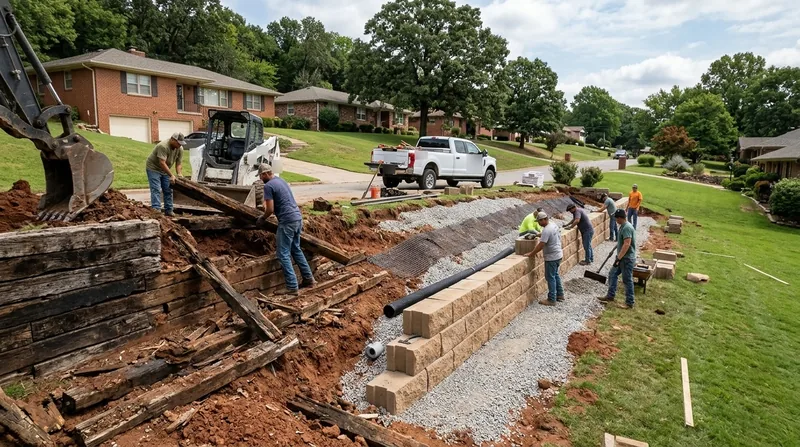




If your backyard in Brookside still has the railroad tie wall a previous owner built in the late 1980s, you already know the signs: ties rotting through, a lean that gets worse every spring, dirt bleeding out between the courses, and a yard that slides an inch closer to the house each rainy season. Railroad Tie Wall Replacement in Tulsa means pulling out those creosote-soaked timbers, hauling them off legally, and rebuilding the wall with segmental block, poured concrete, or native sandstone that actually holds on our red clay. Tulsa sits where the Osage Hills drop into the Arkansas River valley, so hillside lots in Gilcrease Hills and south Tulsa around Turkey Mountain put real lateral load on old timber walls. Our crews do the demolition, the drainage, and the rebuild, and we handle the permitting questions with the local building department. If your wall is already leaning or bulging, start with leaning and collapsed wall repair before the next heavy rain pushes it over.
Why Aging Railroad Tie Walls Fail Fast in Tulsa's Clay and Freeze-Thaw Cycles
Ties from the 1980s and 90s were never meant to last forty years in Oklahoma ground. Our red expansive clay swells when it soaks up spring rain and shrinks hard in summer, which racks the wall back and forth until the ties crack and the pins work loose. Add ice storms, freeze-thaw cycles, and heavy spring downpours, and a timber wall that looked fine in 2010 can be a liability by 2025.
- Creosote-treated ties rot from the inside out where they meet wet soil and backfill.
- Expansive clay pushes the base course out of line and opens gaps between ties.
- Old walls were built with little or no gravel drainage, so hydrostatic pressure builds behind them.
- Freeze-thaw cycles crack ties and loosen the tie-back hardware holding the wall in place.
- Heavy spring runoff through Joe Creek and Mingo Creek corridors saturates slope soils and speeds up failure.
Once water is trapped behind a timber wall, the fix is never cosmetic, and patching ties buys you one or two seasons at best.
Key info: A 1992 railroad tie wall on a sloped lot in Maple Ridge or Florence Park that now leans more than two inches over its height is a rebuild, not a repair. We see this most on south-facing hillside yards where summer sun bakes the clay and winter ice works the joints.
For permit thresholds and inspection requirements, verify current rules with the City of Tulsa building department at cityoftulsa.org before any wall work starts.
How We Tear Out and Rebuild a Railroad Tie Wall in Tulsa
Every replacement starts with a site walk to measure wall height, check the slope above and below, and find out what is buried behind the ties. We look for utilities, old footings, and the real reason the wall failed, because rebuilding on the same bad drainage just resets the clock. Then we sequence the work so your yard stays usable and the new wall goes in right.
- We mark utilities and confirm setback and property-line requirements with the local building department.
- We demolish the old ties, cut them to manageable lengths, and haul them off for proper disposal.
- We excavate to a stable footing on shale or firm clay, not on loose fill.
- We install new gravel backfill, filter fabric, and perforated drain pipe to move water away from the wall.
- We build the new wall in segmental block, poured concrete, or natural sandstone, compacting lifts as we go.
- We backfill, grade the slope above the wall, and clean up the site.
Most replacements wrap up in two to five days depending on wall length, access, and how much old tie material has to come out by hand.
Key info: On a recent job in Jenks, a 60-foot tie wall along a driveway had no drainage at all. We rebuilt it in segmental block with a gravel chimney and drain pipe tied into the yard grade, and the homeowner stopped losing gravel into the drive every storm. See how we handle similar work in Jenks 74037.
Replacement Approaches We Use on Tulsa Tie Walls
Not every tie wall should be replaced with the same material. A short garden wall behind a Brookside bungalow and a tall hillside wall above a walkout basement in Bixby need different answers, and we price and build them differently. The table below shows the approaches we use most in Tulsa.
| Approach | Description | Best for |
|---|---|---|
| Segmental block replacement | Engineered block courses with gravel backfill and drain pipe. | Most residential tie walls up to 6 feet. |
| Poured concrete replacement | Reinforced concrete wall formed and poured on a stable footing. | Tall walls and walls carrying a surcharge. |
| Natural sandstone rebuild | Native sandstone laid with proper batter and drainage. | Older neighborhoods and visible garden walls. |
| Tiered replacement | Two or three shorter walls stepped up a steep slope. | Hillside lots in Gilcrease Hills and south Tulsa. |
We match the material to the slope, the load, and how the wall looks from the house and street, not to whatever is cheapest to install.
Railroad Tie Wall Replacement Cost in Tulsa: What to Expect
Replacement pricing starts at $35 per square foot for a straightforward segmental block rebuild with new drainage, and that figure is a starting point, not a flat rate. Wall height, access, and how much old tie material has to be cut out by hand move the number up or down. Tall walls or walls that support a driveway may need engineered drawings, which adds design and inspection cost.
- Wall height and total square footage drive the base price more than any other factor.
- Limited access, like a wall behind a pool or tight side yard, means hand demolition and higher labor.
- Material choice moves the price most: block costs less than poured concrete or natural sandstone.
- Drainage scope, including drain pipe, gravel, and regrading, is part of a proper rebuild and is priced in.
- Haul-away and disposal of creosote-treated ties add a line item that cheap quotes often skip.
Get two or three written estimates on the same scope so you can compare what each contractor actually includes. Our full breakdown is on the pricing page.
Railroad Tie Wall Replacement Near Me: What Tulsa Homeowners Should Know Before Hiring
When you search for railroad tie wall replacement near me, you get a long list of contractors, and not all of them are set up to do this work legally or safely. Creosote ties are regulated waste, and a contractor who hauls them to the curb instead of a proper disposal site is creating a problem for you. Ask questions before you sign anything.
- Confirm the contractor is fully insured, and ask for a certificate of insurance before work starts.
- Get at least two or three written estimates that list demolition, disposal, drainage, and materials separately.
- Ask for local references on tie wall replacements within the last year, and call them.
- Ask who pulls the permit if your wall is above the local height threshold or supports a surcharge.
- Check HOA rules for wall height, material, and color before the crew shows up.
If a quote looks far below the others, ask what is missing, because it is usually the drainage or the disposal. Reach us through the contact page to set up a free estimate.
Railroad Tie Wall Replacement in Tulsa: Pricing Guide
| Service | Price | Details |
|---|---|---|
| Segmental block tie wall replacement | Starting at $35/sq ft | Includes tie demolition, haul-away, gravel backfill, drain pipe, and new block wall. |
| Poured concrete replacement | Starting at $55/sq ft | Reinforced concrete wall on a stable footing, priced up for height and surcharge loads. |
| Natural sandstone rebuild | Starting at $65/sq ft | Native sandstone laid with proper batter and drainage, priced by stone availability. |
| Complex or large-scale job | On estimate | Tiered walls, engineered drawings, tight access, or walls above 4 feet need an on-site look. |
| Travel | Included | In Tulsa and surrounding areas, no separate call-out or mileage fee. |
| Estimate | Free | Response within 24h at (918) 359-8655, no obligation to book. |
Indicative pricing, the exact cost depends on square footage, finish, and site access. Free personalized estimate within 24h at (918) 359-8655.


