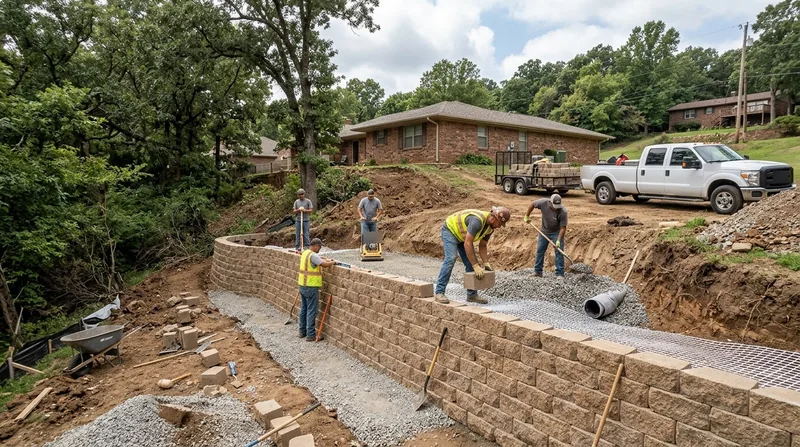




Retaining Wall Installation in Tulsa
Tulsa sits where the Osage Hills roll down into the Arkansas River valley, and that terrain shows up in every backyard from Gilcrease Hills to the ridges above Turkey Mountain. Lots in Maple Ridge and Brady Heights step down toward creek corridors like Joe Creek and Mingo Creek, while south Tulsa properties back up to wooded slopes that shed water fast. The soil under most of these yards is red expansive clay over shallow shale and sandstone, and it moves with every wet spring and freeze-thaw cycle. That combination is exactly why a wall built without a proper footing, gravel backfill, and drainage fails within a few seasons. Retaining Wall Installation in Tulsa done right means designing for the clay, the slope, and the water before anyone sets a block. We build walls that hold the hillside, protect the driveway, and stay plumb through ice storms and summer downpours. If your existing wall is already bowing, start with retaining wall repair before the failure spreads.
Why Retaining Wall Installation Matters on Tulsa's Red Clay and Hillsides
Tulsa's expansive clay is the single biggest reason walls fail here. It swells after a spring storm and shrinks in a dry August, and that cycle pushes against the back of a wall year after year. On the wooded ridges around Turkey Mountain and in the older neighborhoods of Brookside and Swan Lake, the grade change is often steep enough that a failed wall takes a patio or a driveway with it. Add freeze-thaw and ice storm loading, and a wall that looked fine in 2010 can be leaning by 2020.
- We set footings below the frost line so the wall does not heave when the ground freezes.
- We install gravel backfill and drainage behind every wall to relieve hydrostatic pressure from clay soil.
- We design tiered and tall walls with engineered drawings when the local building department requires them.
- We match the wall to the house, from native sandstone in Maple Ridge to segmental block in south Tulsa subdivisions.
Getting the drainage and footing right at installation is what separates a 30-year wall from a 5-year wall.
Key info: A 3-foot wall in a Jenks backyard on flat ground is a straightforward build. A 6-foot tiered wall holding a driveway in Gilcrease Hills needs engineering, a deeper footing, and a drainage plan. Same city, very different job.
Permit thresholds vary by jurisdiction, so always confirm with the City of Tulsa building department or the relevant suburban authority before work begins. You can review the city's permit resources at cityoftulsa.org.
How We Build a Retaining Wall in Tulsa, Step by Step
Every wall starts with a site walk and a conversation about what the wall needs to do. We look at the slope, the soil, the drainage path, and the access for equipment before we quote a number. Then we build in a sequence that keeps the wall stable for decades, not seasons.
- We evaluate the slope, soil, and water path, and we confirm whether a permit or engineered drawing is required.
- We excavate to the designed depth and compact a gravel base below the frost line.
- We set the first course level and true, because everything above it follows that line.
- We install drainage gravel, filter fabric, and a perforated pipe that outlets away from the wall.
- We build up in lifts, compacting backfill as we go to control settlement in the clay.
- We cap the wall, clean the site, and walk you through the drainage outlets before we leave.
That sequence is the same whether we are building a boulder wall in Bixby or a poured concrete wall in Owasso.
Key info: On a recent Sand Springs job, a homeowner's old railroad tie wall had rotted through and the slope was sliding into the driveway. We removed the ties, stepped the new segmental block wall back into the hill, and tied the drainage into a French drain that outlets at the curb. See how we handle that scope on our railroad tie wall replacement page.
Retaining Wall Methods We Use Across Tulsa
The right material depends on the height, the load, the soil, and the look you want. We build all the common wall types used in Tulsa, and we will tell you plainly which one fits your yard.
| Approach | Description | Best for |
|---|---|---|
| Segmental block (SRW) | Interlocking concrete block with gravel backfill and geogrid as needed. | Most residential slopes and terraced yards. |
| Poured concrete | Reinforced cast wall with a formed face and proper footing. | Tall walls and walls carrying a surcharge. |
| Boulder and natural stone | Native sandstone and fieldstone set on a compacted base. | Rustic and hillside landscapes, older Tulsa lots. |
| Timber | Pressure-treated timbers with proper drainage behind. | Low garden walls and budget-conscious builds. |
| CMU block | Concrete masonry units with reinforced cores where required. | Straight structural walls and property lines. |
We match the method to the load and the soil, not to whatever material is easiest to sell.
Retaining Wall Installation Cost in Tulsa: What to Expect
Most residential retaining wall installation in Tulsa starts around $30 per square foot of wall face, and that figure moves up or down based on height, access, material, and engineering. A low garden wall on flat ground in Broken Arrow sits near the bottom of that range. A tall wall holding a driveway in Gilcrease Hills, with limited equipment access and engineered drawings, lands well above it. The square footage of the wall face, not the length of the yard, is what drives the number.
Access is the factor homeowners underestimate most. A wall you can reach with a mini excavator and a skid steer is faster and cheaper than one you have to build by hand behind a house with no gate. Material choice matters too: segmental block is usually the best value, boulder and natural stone cost more in labor, and poured concrete adds forming and engineering. Clay soil that needs over-excavation and imported gravel backfill also adds cost. Get two or three written estimates that spell out footing depth, drainage, and disposal, then compare scope, not just the bottom line. Our pricing overview breaks down the ranges in more detail.
Hiring a Retaining Wall Contractor Near Me in Tulsa: What to Check
Retaining wall work is structural, and the contractor you hire should be able to show it. Ask for proof of licensing and insurance before anyone walks your slope, and get the certificate sent to you directly. Ask how they handle drainage and footings, because a contractor who skips that conversation will skip it on the job too. And ask whether they pull permits when the wall height or surcharge requires it.
- Confirm the company is fully insured, and ask for a certificate of insurance.
- Get two or three written estimates that itemize footing, drainage, material, and disposal.
- Ask for references from walls built at least three years ago, not just last month.
- Check whether permits and engineered drawings are required for your wall height and surcharge.
- Review HOA rules for wall height, material, and color before you sign a contract.
A contractor who answers these questions clearly is the one you want holding the footing on your hillside.
Ready to talk through your slope? Reach out through our contact page and we will set up a free on-site estimate.
Retaining Wall Installation in Tulsa: Pricing Guide
| Service | Price | Details |
|---|---|---|
| Low garden wall (under 3 ft) | Starting at $30/sq ft | Includes compacted gravel base, drainage gravel, and cap; cost rises with limited equipment access. |
| Structural wall (3 to 6 ft) | Starting at $45/sq ft | Includes deeper footing, geogrid where needed, and perforated drain; height and surcharge load move the price. |
| Engineered or tiered wall | On estimate | Requires stamped drawings, over-excavation of clay, and staged backfill; needs an on-site review before pricing. |
| Boulder and natural stone wall | Starting at $55/sq ft | Includes stone sourcing and hand setting; stone size and haul distance drive the final number. |
| Travel | Included | In Tulsa and surrounding areas, no separate call-out or mileage fee. |
| Estimate | Free | Response within 24h at (918) 359-8655, no obligation to book. |
Indicative pricing, the exact cost depends on square footage, finish, and site access. Free personalized estimate within 24h at (918) 359-8655.


