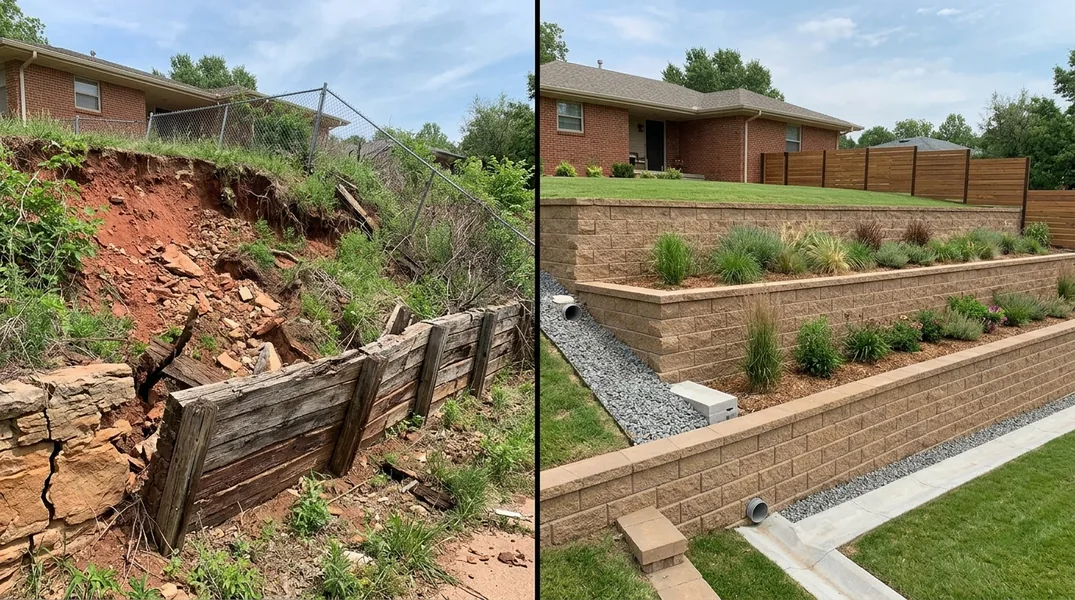
Why Retaining Wall Materials Matter So Much in Tulsa
If you live in Tulsa, you already know the ground here is not like the sandy or rocky soils you see in other parts of the country. Much of the area sits on expansive red clay that swells when it absorbs water and shrinks as it dries. That constant cycle of movement puts serious pressure on any wall holding back a slope, and it is the single biggest reason material choice matters more here than in most markets.
Hillside lots bring a second challenge. When a yard slopes away from the house, a retaining wall has to manage both the weight of the soil behind it and the water that drains through that soil during a heavy spring storm. A wall that looks fine on paper can fail within a few seasons if the material cannot handle clay movement and poor drainage. Homeowners researching options online should start by understanding how each material performs specifically in Oklahoma conditions, not just how it looks in a brochure. That is exactly what this guide covers.
Concrete Retaining Walls: Strength for Heavy Clay Loads
Concrete Retaining Walls are the heavyweight option, and on Tulsa hillside lots they often make the most sense. Poured concrete can be engineered to resist the lateral pressure that expansive clay generates, and it holds up well against freeze and thaw cycles. For tall walls or walls supporting a driveway or structure above, concrete is frequently the safest choice because its strength can be calculated and reinforced with rebar precisely for the load.
The tradeoff is appearance and cost. A plain concrete wall can look industrial, though many homeowners finish it with a textured face, stain, or stone veneer to soften the look. Installation also requires more site work and curing time than stacked block. If you are weighing options and want to know how concrete compares on pricing, a site visit is the only way to get a real number, since wall height, soil conditions, and access all change the equation. For a wall that absolutely must not move, though, concrete is hard to beat in red clay country.
Block and Segmental Retaining Walls: The Versatile Middle Ground
Block retaining walls and segmental retaining walls are closely related, and together they are the most popular choice for residential projects in the region. Segmental systems use interlocking units that stack without mortar, and many are engineered specifically for soil retention with built-in setback and drainage channels. That flexibility makes them a strong fit for the moderate-height walls common on Broken Arrow and Tulsa residential lots, where a wall might terrace a backyard or hold a planting bed.
Modern segmental blocks come in dozens of colors and textures, so you can match brick, stone, or a clean contemporary look. They also handle minor settlement better than rigid materials because the joints can flex slightly instead of cracking. The key is proper installation: a compacted gravel base, correct geogrid reinforcement for taller walls, and a drainage system behind the blocks. When those details are handled correctly, a block wall can last decades. When they are skipped, even a quality block will shift. This is where experienced Retaining Wall Installation makes the difference between a wall that lasts and one that leans within a few years.
Sandstone Retaining Walls: Natural Looks for Oklahoma Landscapes
A sandstone retaining wall brings a warm, natural appearance that fits the Oklahoma landscape beautifully. Sandstone is a popular choice for garden walls, terracing, and low walls where curb appeal matters as much as function. The earthy tones blend well with native plants and stone landscaping, and the texture reads as established and organic rather than manufactured. For homeowners in neighborhoods around Jenks who want a wall that looks like it belongs on the property, sandstone is often the first material they ask about.
Sandstone does have limits. It is generally best suited to lower walls and decorative applications, because natural stone varies in strength and may not handle the same lateral loads as engineered concrete or segmental block. It also requires a skilled mason to set properly so the wall stays stable through clay movement and freeze cycles. If your project involves a tall wall or a slope that carries significant weight, sandstone may work as a facing or accent rather than the structural solution. A professional assessment will tell you honestly which role sandstone can play on your specific lot.
Retaining Wall Installation Near Me: Matching Material to Your Lot
Searching for retaining wall help near me usually means you have a slope that is eroding, a driveway cracking, or a backyard you cannot fully use. The right material depends on factors you cannot judge from a photo: how tall the wall needs to be, what the soil is doing, where water drains, and whether heavy equipment can reach the site. A wall holding back four feet of red clay on a Bixby hillside is a different engineering problem than a two-foot garden terrace, and the material should reflect that difference.
This is also why existing walls sometimes need attention rather than replacement. A leaning block wall may be repairable with better drainage and reinforcement, while a cracked concrete wall might need partial rebuilding. Our team handles Retaining Wall Repair and can advise whether repair or full Retaining Wall Replacement is the smarter investment. Either way, the goal is the same: a wall designed for Oklahoma clay and built to drain properly from day one.
Retaining Wall Installation Cost in Tulsa: What to Budget
Homeowners often ask for a ballpark before anyone has seen the yard, and it is fair to want one. The honest answer is that retaining wall cost in Tulsa varies widely based on wall height, total square footage, material choice, site access, and how much excavation and drainage work is required. A short segmental block wall along a planting bed sits at one end of the range, while an engineered concrete wall on a steep hillside sits at the other. Soil conditions in red clay can also add to excavation and backfill costs compared with easier sites.
Rather than guessing, the most useful step is a walkthrough with a professional who can measure the slope, check drainage, and recommend a material that fits both your budget and your lot. We provide a free estimate so you can see real numbers for your property instead of generic ranges. Call Tulsa Retaining Wall at (918) 359-8655 to schedule a visit and get clear, written options for your project.
Looking for a professional retaining wall contractor in Tulsa? Tulsa Retaining Wall responds fast for all your retaining wall needs.
Get a Free QuoteOur services: Retaining Wall Installation · Retaining Wall Repair · Retaining Wall Replacement